Is there such a thing as a standard non-disclosure agreement? Not really. Two NDAs can look almost identical and still protect very different things, because the right wording depends on who is sharing what, why, and where. Download a free template and you inherit somebody else's answers to those questions.
In the video below, our lawyer drafts a complete NDA with FD AI in under ten minutes and explains each question, and each clause, along the way. This article sets out the same walkthrough in writing, with screenshots of every step, so you can follow along and draft your own as you read.
Before you start: what you'll need
You can begin with nothing but a name, and FD AI will leave clear blanks for anything you skip. But you will get a sharper first draft if you have these to hand:
The seven questions that shape your NDA
FD AI asks these questions one at a time, in plain English, and shows your progress on the right. You can skip anything you are unsure about and come back to it later.
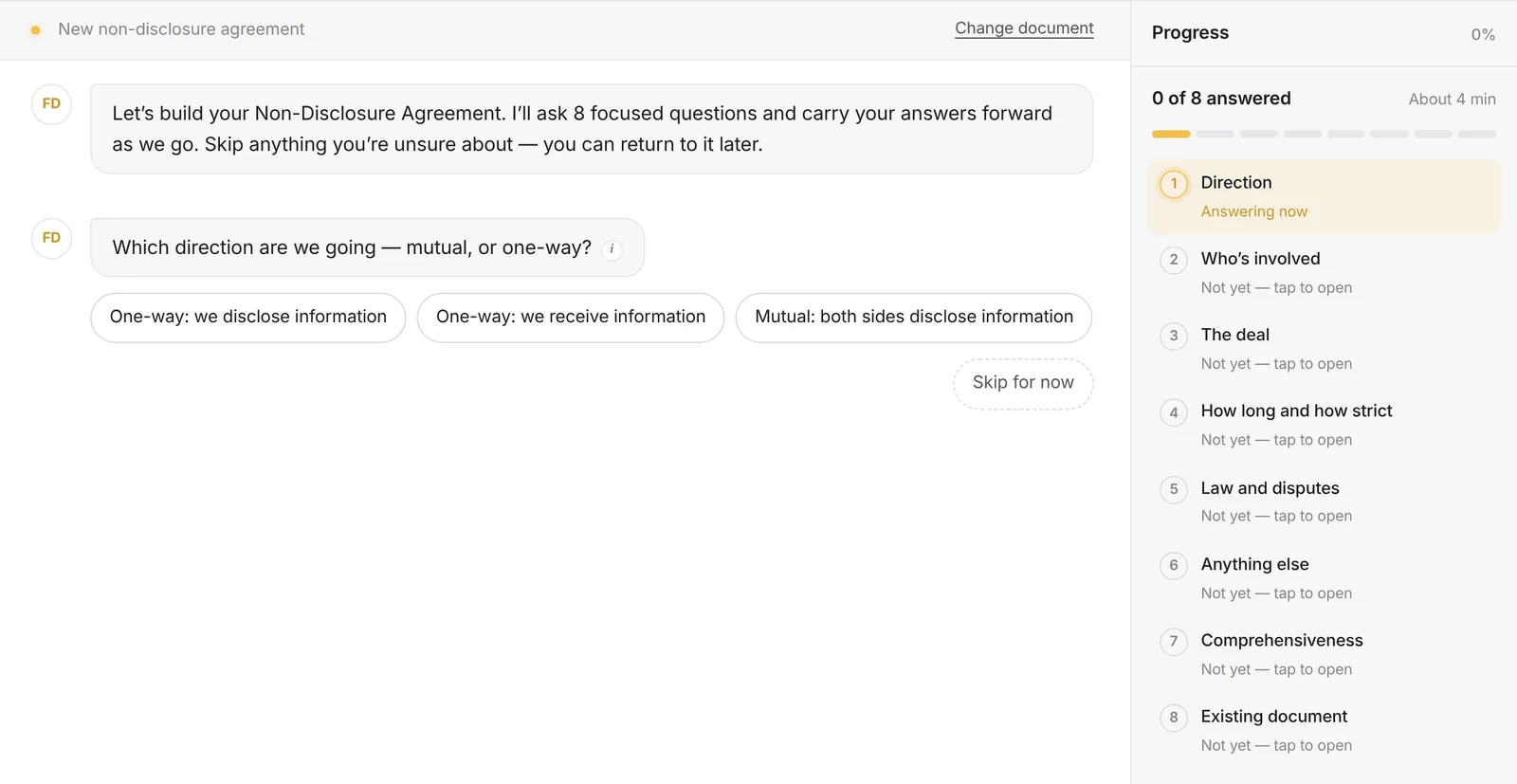
1. Which direction is the information flowing?
Start with the direction. Are you receiving the information, disclosing it, or are both sides sharing (a mutual NDA)? It matters more than it seems, because it decides whose interests the wording should lean towards.
| If you are… | Choose | What you want from the NDA |
|---|---|---|
| 🔒 Sharing your information only | One-way NDA (you disclose) | Tight obligations, a broad definition of confidential information, strong remedies. |
| 📥 Receiving someone else's information | One-way NDA (you receive) | Flexibility, clear exceptions, and no promise you cannot keep. |
| 🤝 Both sharing | Mutual NDA | Balanced obligations that apply equally to both sides. |
And if you are happy for anyone to have the information, you may not need an NDA at all. Read NDA vs Confidentiality Agreement: What is the Difference?
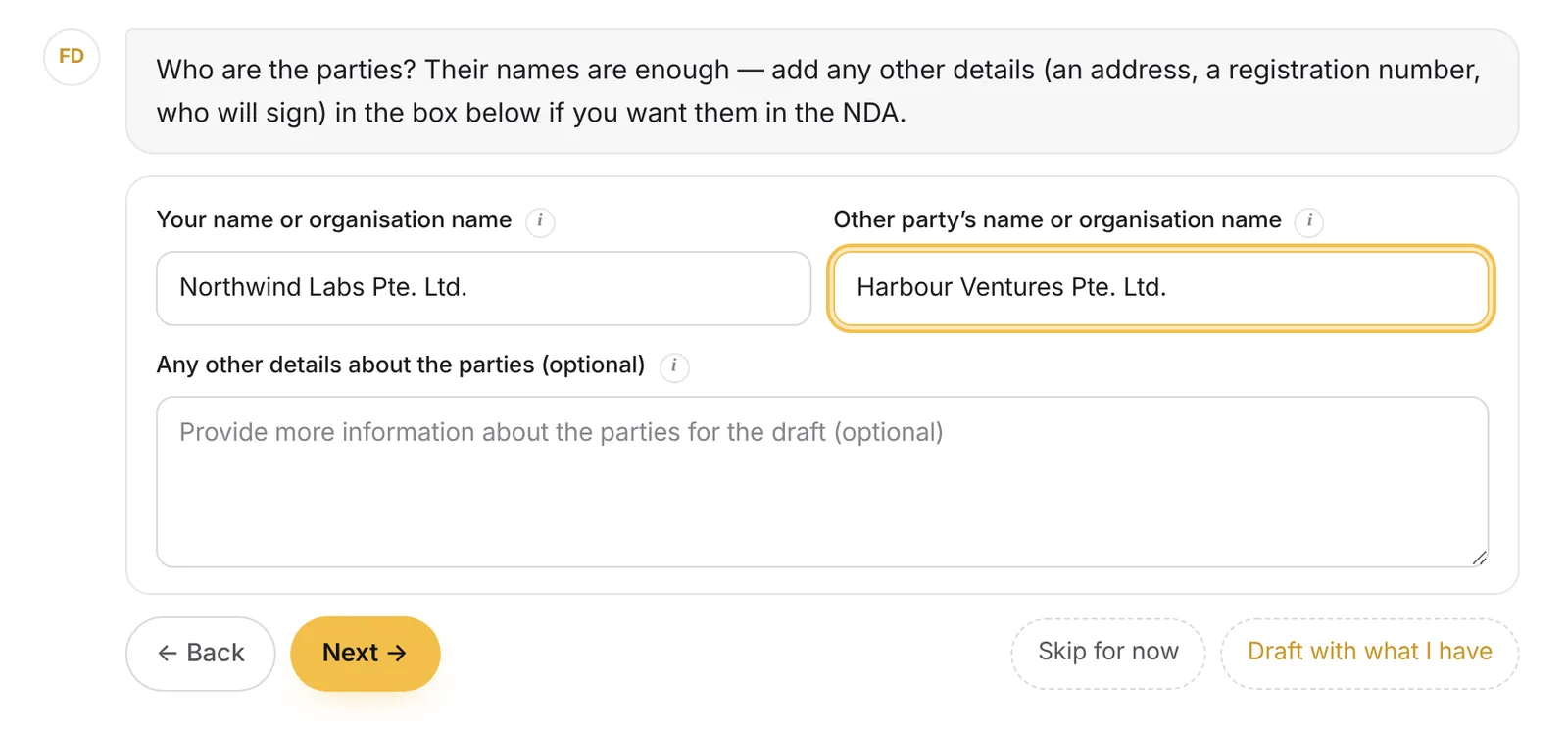
2. Who are the parties?
Next come the parties. Use each party's full legal name, not a brand or trading name, so there is no doubt later about who is bound. A group holding company and its operating subsidiary are different parties, so name the one that will actually receive or share the information.
3. What are you working on together?
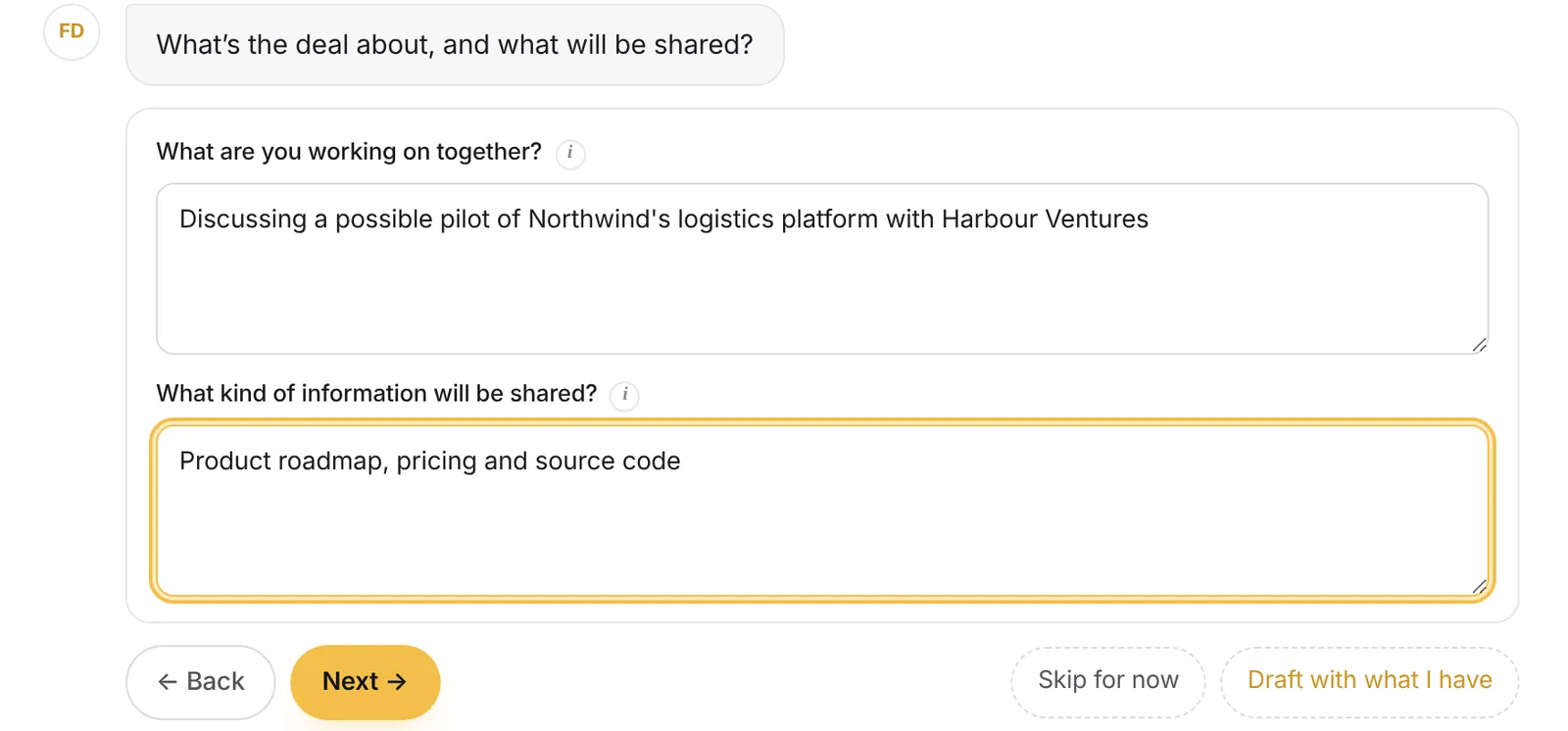
This question sets the purpose, and the purpose is the boundary. The other side may use your confidential information only for that purpose and nothing else. If you are sharing information to explore a possible acquisition, the recipient cannot use it for anything else, such as learning your competitive secrets.
| Purpose | Verdict |
|---|---|
| "Business discussions" | ❌ Too vague. Almost any use could fit. |
| "Reviewing the Q3 pricing sheet on 14 October" | ❌ Too narrow. Follow-up calls may fall outside it. |
| "Discussing a possible pilot of Northwind's logistics platform with Harbour Ventures" | ✅ Specific about the project, flexible enough for the talks around it. |
4. What counts as confidential information?
Think about what is protected and what falls outside. It sounds dull, but it stops being dull very quickly when the parties start arguing over whether something was confidential at all. Name the categories that matter to you: product roadmaps, pricing, source code, customer lists, financials. A clear definition now saves a dispute later.
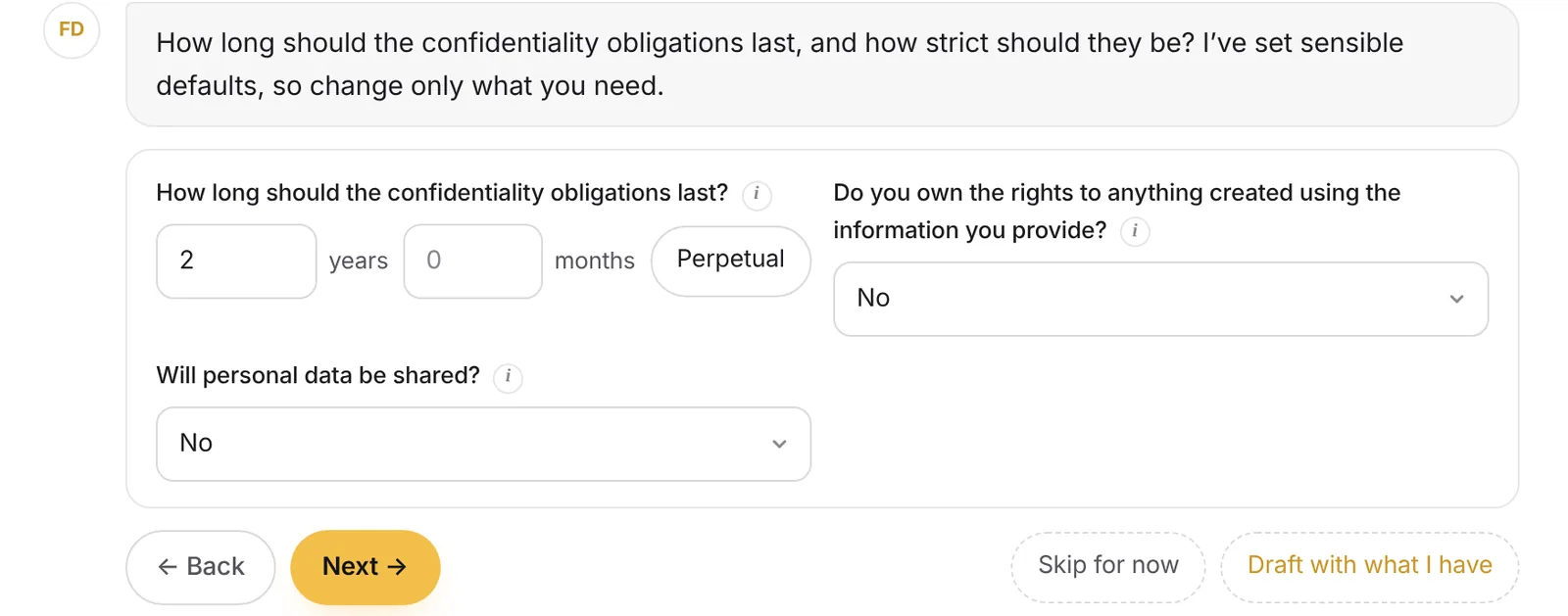
5. How long should confidentiality last?
Two to five years is common, and nothing stops you from asking for longer if the information will stay sensitive. Trade secrets are often protected for as long as they remain secret. FD AI sets a sensible default, so you change only what you need.
| What you are sharing | Typical duration |
|---|---|
| ⏱️ Early, exploratory talks | 1 to 2 years |
| 💼 Pricing, business plans, deal terms | 2 to 5 years |
| 🧬 Source code, formulas, trade secrets | As long as the information stays secret |
Don't forget personal data. If what you share includes personal data, such as customer records or employee details, it has to be handled properly. The NDA should place additional obligations on the recipient under the data protection law that applies, such as Singapore's Personal Data Protection Act 2012 (PDPA) or the EU's General Data Protection Regulation (GDPR). Many businesses have been caught out here, so it is worth a minute of your time. Answer "Yes" in FD AI and the draft adds data protection obligations for you.
6. Where are you based?
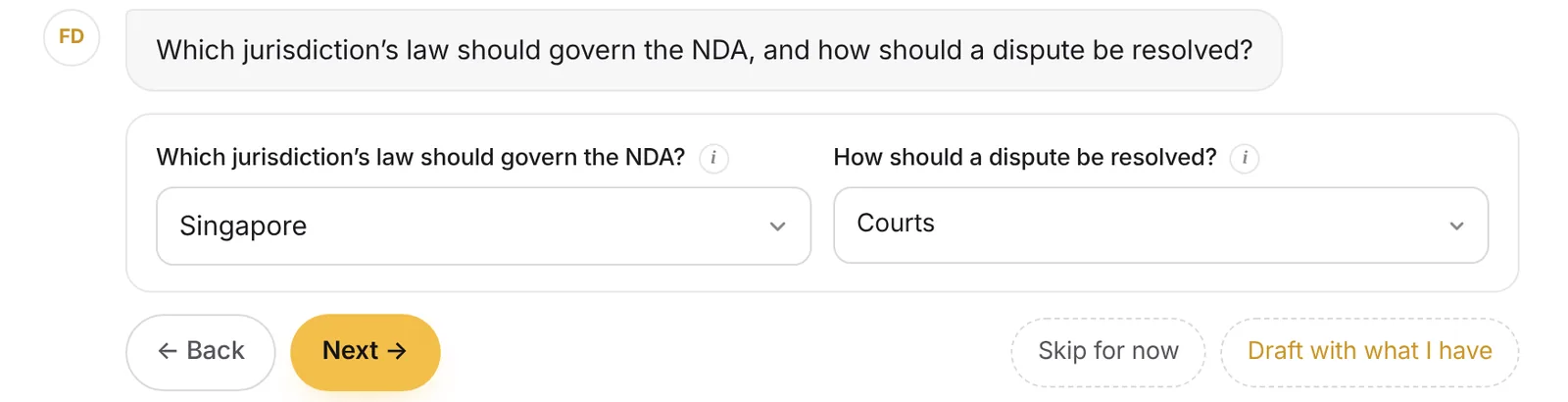
The jurisdiction question decides which country's law governs the NDA and where a dispute would be resolved. Usually the simplest answer is where you are based. FD AI lets you search for any country or state, then choose how disputes are resolved, for example in the courts.
7. How comprehensive should the NDA be?
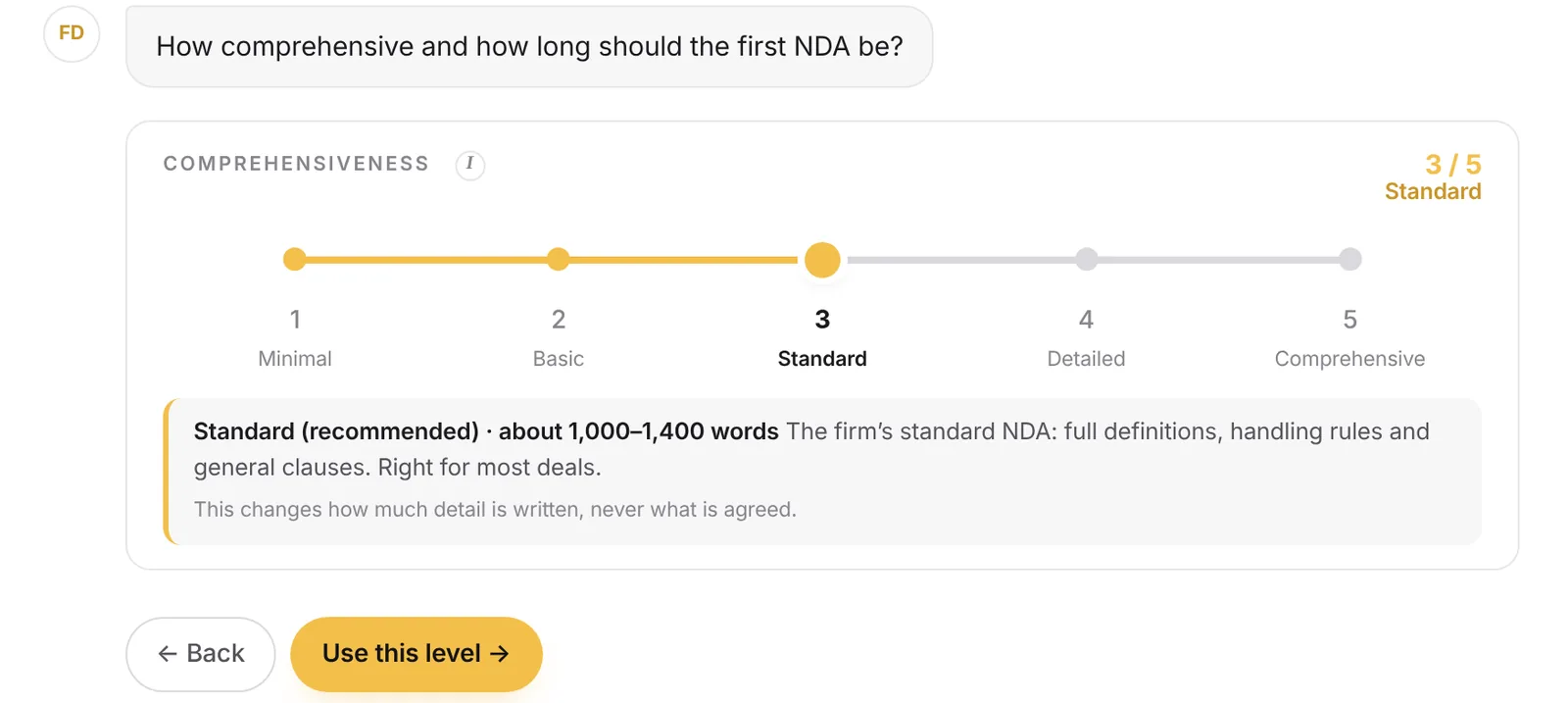
If you are disclosing, you may want a very comprehensive agreement. If you are receiving, you may prefer something shorter and simpler. It also depends on the parties' preferences and how far along the discussions are: a long, detailed NDA can be overkill for a first conversation.
| Short and simple | Comprehensive | |
|---|---|---|
| Best for | First meetings, receiving parties, low-risk information | Disclosing parties, valuable IP, larger deals |
| Reads like | Two or three pages a busy founder will actually sign | Full definitions, security rules and remedies |
| Watch out for | Gaps if the relationship deepens | Slowing down a deal that does not need it |
Generating the draft, for your jurisdiction
Once the questions are answered, click Generate draft. A question we often get is whether the NDA is specific to each jurisdiction. It is. Every country has its own rules that affect NDAs, and your answers carry through into the draft, so the clauses and conventions match the country you chose. The core principles of a non-disclosure agreement are the same in most places, which is why the seven questions stay the same.
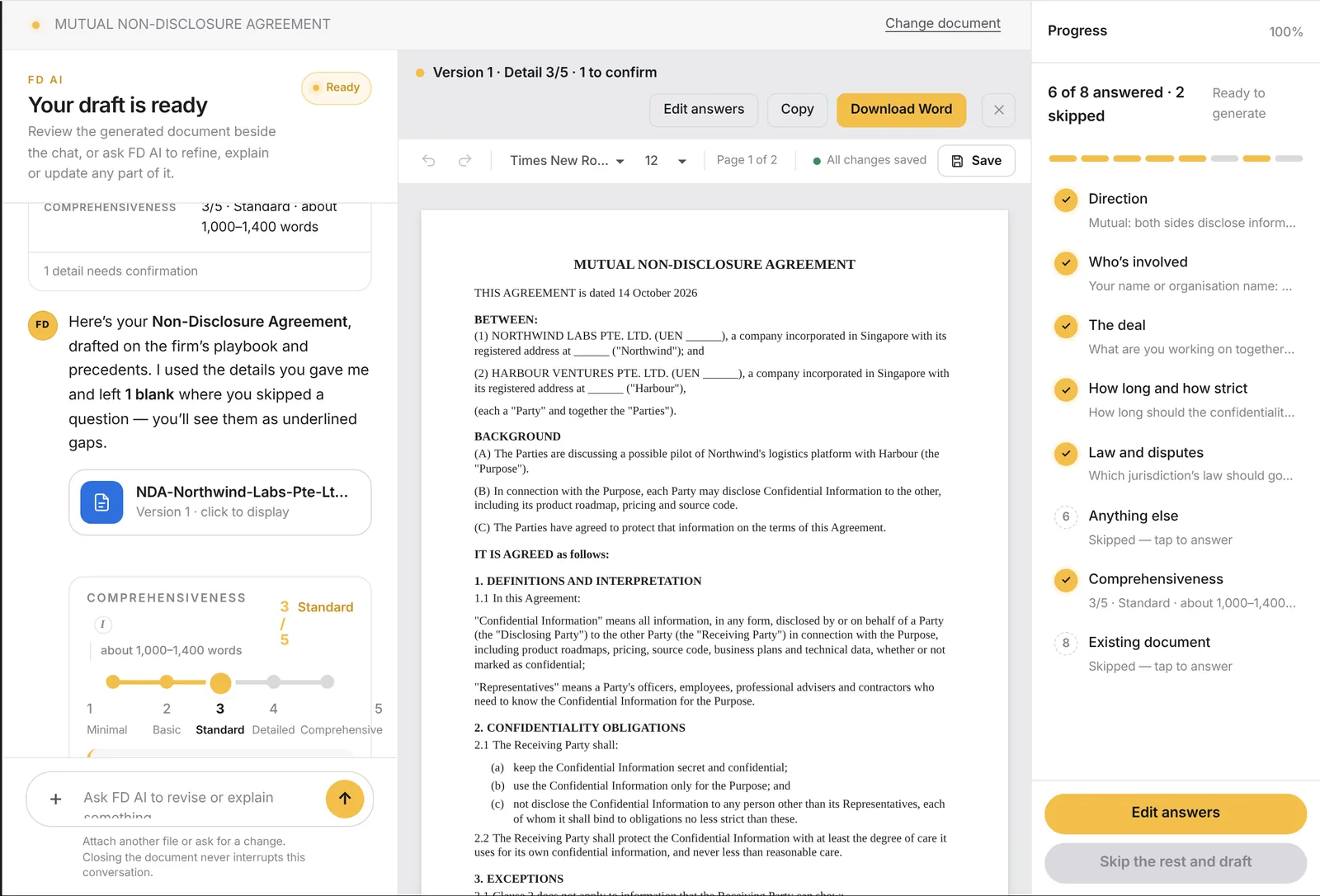
Anything you skipped is left as a clear blank, and FD AI lists the gaps to fill before the NDA goes out.
What's inside the draft: the key clauses
Your answers become the clauses. Here is what to look for when you read the draft:
| Clause | What it does | Why it matters |
|---|---|---|
| Purpose | The recipient may use the confidential information solely for the agreed purpose. | Stops the information being used for anything else, such as competing with you. |
| Confidentiality and representatives | Keep the information strictly confidential; disclose it only to representatives who need it, such as lawyers, accountants and key staff. | Representatives must be bound by the same confidentiality. |
| Security measures | Sets out how the information must be protected, with checks and balances. | For example, not leaving it freely available across the company, and making clear who is authorised to use it. |
| Exceptions | Disclosure required by a court, regulator or government agency, and information that is public, already known or independently developed. | Where possible, the disclosing party should be told first. |
| Ownership | Sharing the information transfers no rights in it: no licence and no ownership. | Any use stays limited to the agreed purpose. |
| No warranty | The disclosing party does not promise the information is accurate or complete. | You want this if you are disclosing, so you are not blamed if the information turns out to be imperfect. |
| Return or destroy | When the relationship ends, the recipient returns or destroys the information, keeping only what the law requires. | Copies do not linger after the deal is over. |
| Remedies | Acknowledges that money alone may not be an adequate remedy. | Supports an application to court for an injunction to stop a threatened disclosure. |
| Term | How long the obligations last, from your answer to question 5. | Trade secrets may be protected without a time limit. |
| Governing law and jurisdiction | Follows the country you chose in question 6. | Decides which law applies and where disputes go. |
Read Can Breaching an NDA Be Expensive?
Five common NDA mistakes to avoid
- Using a brand name instead of the legal entity. If the wrong company signs, the right one may not be bound.
- A purpose so broad it means nothing. "Business discussions" lets the recipient argue that almost any use was allowed.
- Forgetting oral and demo information. If only marked documents are protected, what you said in the meeting may not be.
- Ignoring personal data. Sharing customer or staff data without data protection obligations can put you on the wrong side of the PDPA or GDPR.
- Sneaking in a non-compete. It does not belong in an NDA, and it can make the other side walk away from a simple confidentiality deal.
Before you send it: a final checklist
A word of caution
No document is one hundred per cent perfect. An AI-drafted NDA gives you a well-structured first draft quickly, but if the information is especially valuable, or you need a watertight agreement, have a lawyer review it. Book a fixed-price FD Consult call with a practising lawyer, or contact us to review the draft with you.
Received an NDA instead? Read Before You Sign an NDA: 10 Things Founders Should Know.
Moving on to a deal? Read What Is a Term Sheet?
For more walkthroughs like this one, visit our podcast and videos.
Frequently asked questions
Is there a standard NDA?
Not really. The right wording depends on the direction of the information, the purpose, what counts as confidential, how long it lasts, whether personal data is involved and which country's law applies.
How long does it take to draft an NDA with FD AI?
About four minutes to answer the questions, and the draft is ready shortly after. You can skip questions and fill the blanks later.
Should I use a one-way or a mutual NDA?
Use a one-way NDA when only one side shares confidential information, and a mutual NDA when both sides do. A mutual NDA is not automatically better.
How long should an NDA last?
Two to five years is common. You can ask for longer if the information will stay sensitive, and trade secrets are often protected for as long as they remain secret.
Should an NDA include a non-compete or non-solicitation clause?
Generally no. Those restrictions go beyond confidentiality and belong in a separate agreement, which is why FD AI leaves them out of an NDA.
What if the information includes personal data?
The NDA should add obligations on the recipient under the data protection law that applies, such as Singapore's PDPA or the GDPR.
Is an NDA drafted with FD AI specific to my country?
Yes. The governing law you choose carries through into the draft, so the clauses and conventions match that jurisdiction.
Can I edit the NDA after it is drafted?
Yes. Edit it on screen, ask FD AI to change or explain any clause, change your answers and redraft, or download it as a Word document.
Sources
- Personal Data Protection Act 2012 (Singapore): sso.agc.gov.sg/Act/PDPA2012
- Personal Data Protection Commission, Singapore: pdpc.gov.sg
- Regulation (EU) 2016/679, General Data Protection Regulation: eur-lex.europa.eu/eli/reg/2016/679/oj
Draft your NDA in minutes
FD AI asks these seven questions and turns your answers into a jurisdiction-specific NDA you can edit on screen or download as Word. Give it a go: your first week is on us.